
From 3 days to 2 hours: how a Berlin firm produces its reports with almost no office work
At a glance
| Client | Rudolf Baumpflege, Berlin |
| The problem | An expert spent days typing paper forms into Word templates |
| Before | about 3 working days of office work for 20 reports |
| After | 2 hours |
| Saving | about 90% of that office work |
| Development time | 1 week to first real use |
| Economics | one-off investment, payback after about 3 months |
| Ongoing costs | low; we handle hosting and maintenance |
| What the software does | reads the handwritten field forms, drafts descriptions from the tree photos, checks the data for errors, and produces the finished report as a PDF |
In short: an experienced surveyor used to finish about eight reports a day, and sat at a desk the whole day without seeing a single tree. Today he reviews and amends, instead of retyping. He still makes the decisions.
Why this case is interesting even if you have nothing to do with trees
On the surface this is about trees. At its core it is a problem many firms know:
The most expensive person in the building spends half the day moving numbers from a sheet of paper into a computer program.
If you would sign one of these three sentences in your own firm, it is worth reading on:
- Someone on site fills in a paper form, and later types it again in the office.
- The same document is produced again and again, only with different numbers in it.
- Specialists do work that does not actually need their training.
That was the starting point at Rudolf Baumpflege.
How the process looked before
Rudolf Baumpflege produces valuation reports for trees. These are official documents: they set what a tree is worth, and they follow a fixed calculation scheme prescribed by an official body.
The path to such a report looked like this:
- The trees in the brief are marked on a map. They first have to be looked up in Berlin’s geoportal.
- The surveyor drives to each tree and records the data: height, crown width, damage, plus photos on the work phone.
- In the office the photos are copied from the phone to the company cloud.
- The handwritten field form is scanned.
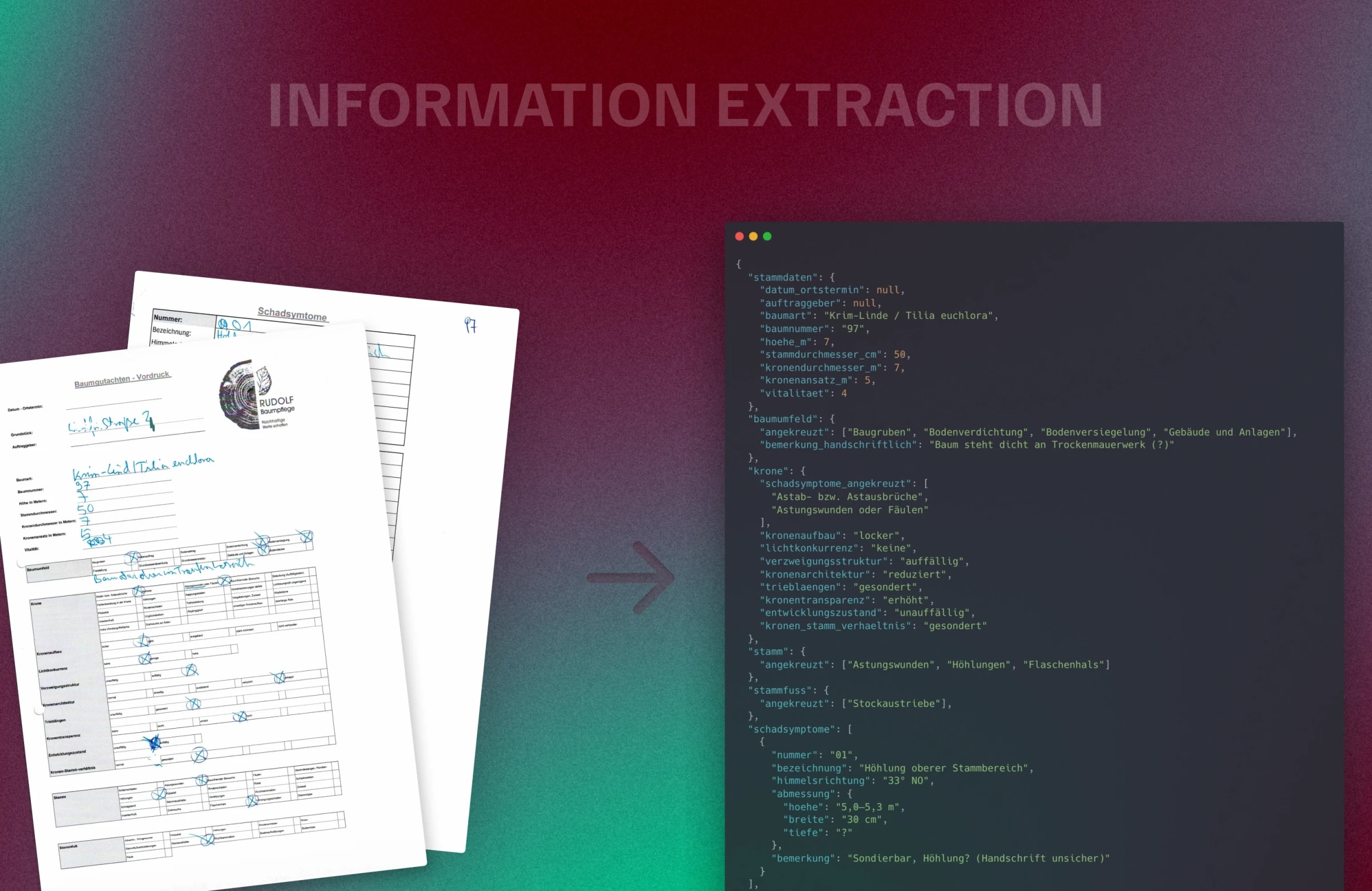
- Then the real grind begins: everything is transferred into a Word template. Crop and insert images, look up reference values in tables, copy text blocks together, write assessments.
For step 5: a practised surveyor finishes about eight reports a day, if he does nothing else.
What that really costs
The value of a report is created in two places: outside at the tree, and in the expert’s professional judgement. Both need experience.
Retyping does not.
Yet that is exactly where most of the time went. Every day at the desk was a day without site appointments. How many jobs the firm could take on did not depend on demand. It depended on the paperwork.
What we built
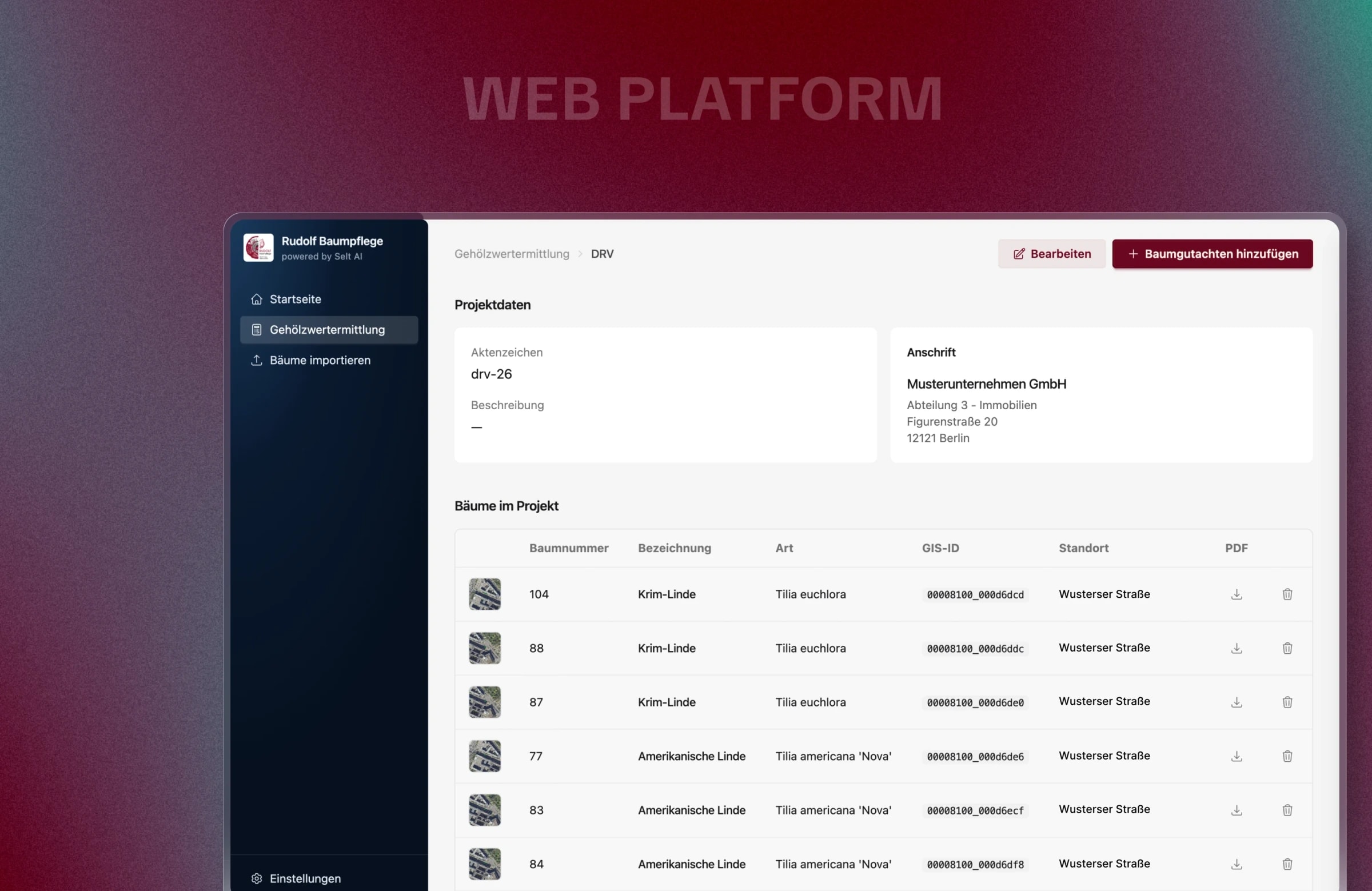
We built a web application. It runs in the browser, nothing needs to be installed, and it is the one place where a valuation job is handled from start to finish.
Manage jobs and trees. Each job is created, and the trees that belong to it are kept inside it. What used to be scattered across folders, Excel lists and filenames now has a fixed place.
The field form is read automatically. The scan is uploaded, the software reads the handwritten entries and puts them into the right fields. No more retyping.
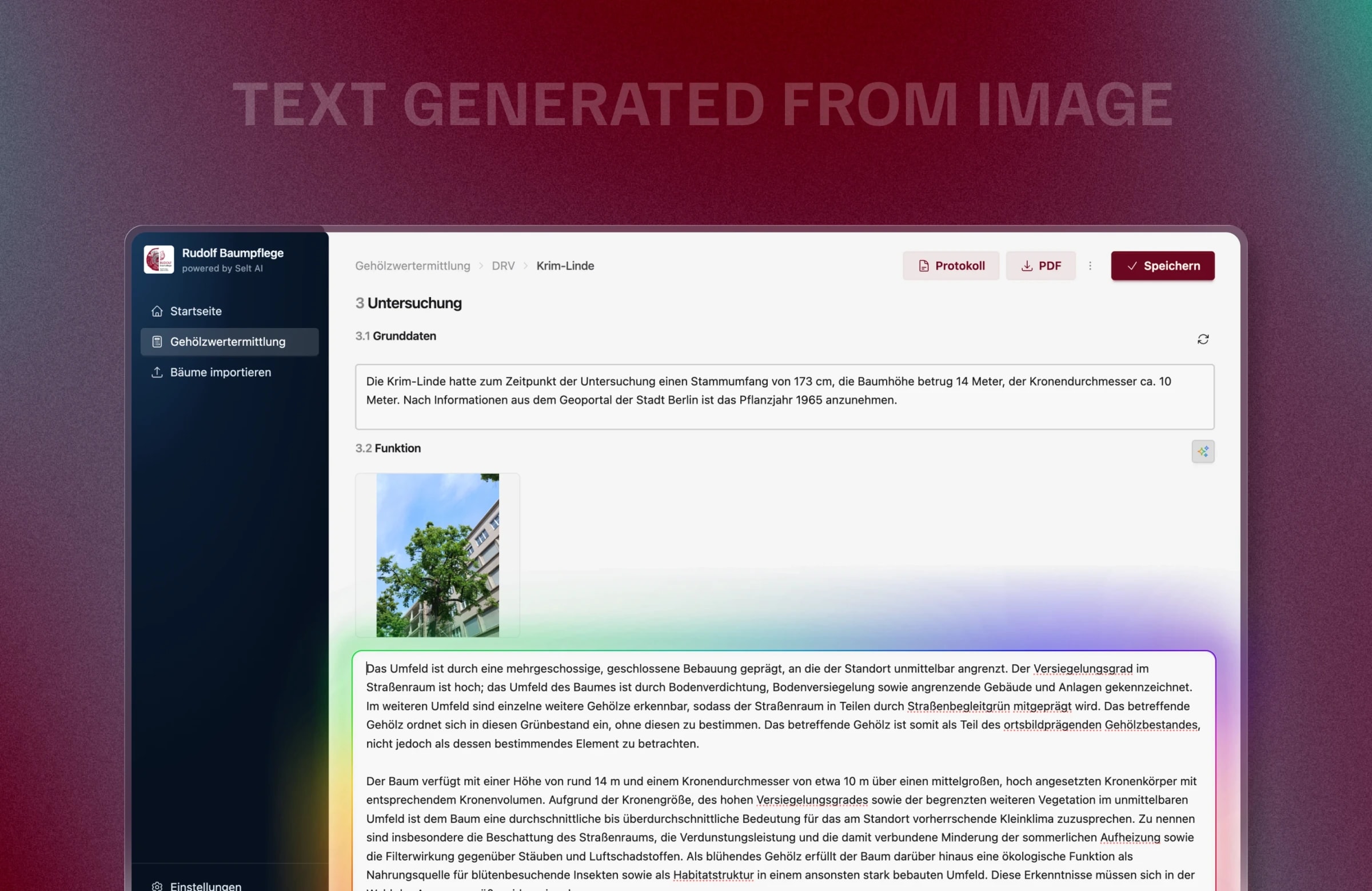
Photos become draft text. The software looks at the tree photos and drafts descriptions of damage and site. For this part, reading the forms and writing the text, we use Anthropic’s AI models (Claude).
The surveyor amends and decides. He still enters his professional assessments himself. Only now in a form that walks him field by field, instead of in a blank Word document.
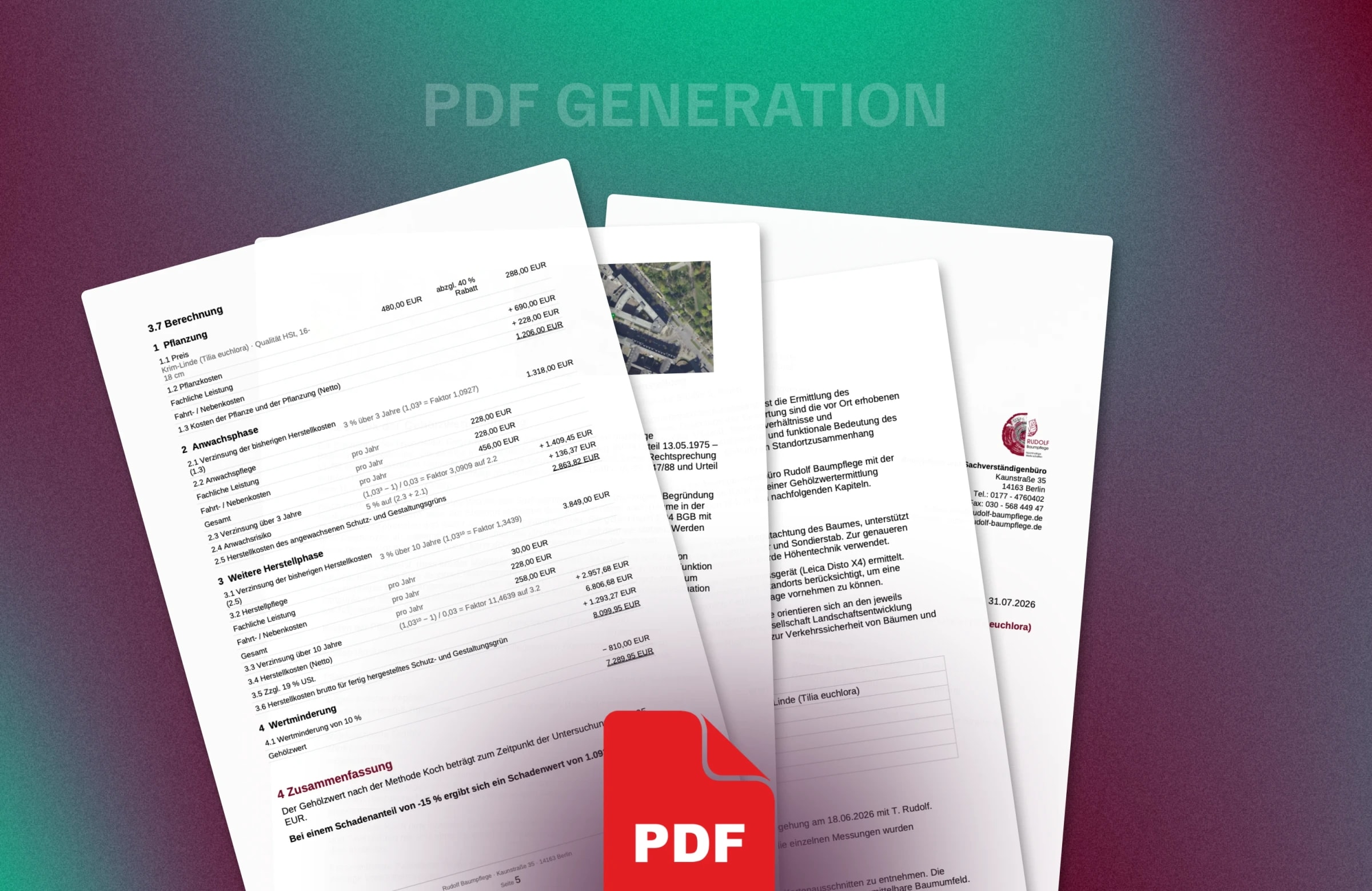
The finished PDF is at the end. One click, and the report is in the familiar layout, ready to send to the client.
The main question: who is liable if the software gets it wrong?
The surveyor’s name is on the report. Not ours. That is why this was the central question for us from the start, and it shaped how the software was built.
The software decides nothing. It proposes. Every automatically generated text is a suggestion the surveyor sees, judges and changes if needed. Nothing goes into the finished document unchecked.
The software checks itself. At several points in the process an automatic plausibility check reports typical errors. A simple example: if the scanned field form shows a different tree number than the job, that is flagged, before it becomes a report.
Everything is inspectable at every point. The process is built so that at each step you can see which data is there and where it came from. Errors show up where they arise, not only in the finished PDF at the client’s.
The result: the surveyor still checks every document. He only has to review instead of produce, and that is many times faster.
Why this was finished in a week
From the first conversation to first real use took one week. That sounds like a sales line, so here is why:
We showed early, instead of describing at length. Instead of developing for weeks from a specification and finding at the end that we had talked past each other, the client saw something usable every few days. Each comment went straight into the next version. Misunderstandings cost hours, not weeks.
The load on the client stayed small. What we needed most was access to a few real examples, filled forms, photos, finished reports, and short comments on the drafts. Nobody had to be pulled out of day-to-day work for the project.
Modern development tools. Software development with AI support is many times faster today than two years ago. That is why such solutions are now viable for a firm with 20 staff, not only for large corporates.
How the numbers work
Custom software sounds like a budget you discuss in the advisory board. So the number that matters more to you first: after about three months the investment had paid for itself.
The sum behind that is simple. For every 20 reports the solution saves about two and a half working days of a specialist. Multiply that by your own volume and your own hourly rates. For most firms the point at which this pays its way is closer than they expect. Everything after that is time saved with nothing on the other side of the ledger.
After that, almost no further cost arises. There is no per-seat licence and no contract that gets more expensive every year. We handle hosting and maintenance. The firm does not have to keep someone in-house for that, and does not need its own IT department.
What a project like this costs at your firm depends on the scope. We settle that in the first conversation, before anyone signs anything.
The result
Office work for 20 reports fell from 3 working days to 2 hours, about 90% less effort.
What used to tie up half a working week at a desk is now a morning. The time freed goes where the surveyor is needed: outside.
What comes next
One step still runs on paper: the recording on site. Next we are therefore building an app for phone or tablet that walks the surveyor through the survey point by point outdoors and captures all data digitally at once.
Then scanning goes as well. Of the original office work, exactly one step remains: check once and approve.
We thank Rudolf Baumpflege for their trust and look forward to the rest of the work together.
Does this sound familiar?
If specialists in your firm transfer data from paper into a computer, instead of doing their actual work, a conversation is worth it. We look at your process and tell you plainly where automation pays, and where it does not.
A first project that builds trust
It shows what AI can already do in your company. After that we take the open topics, if they make sense. We do not promise what we cannot keep.
Let's talk about your project